LLM SEO services help a brand get named, quoted and linked in the answers that AI assistants such as ChatGPT, Gemini, Perplexity, Claude and Google’s AI features assemble. Instead of only ranking pages, LLM SEO makes your facts easy to retrieve, consistent across the web and credible enough for a model to cite. Vidco Group runs it as a measured, five-step loop with no guaranteed placements.
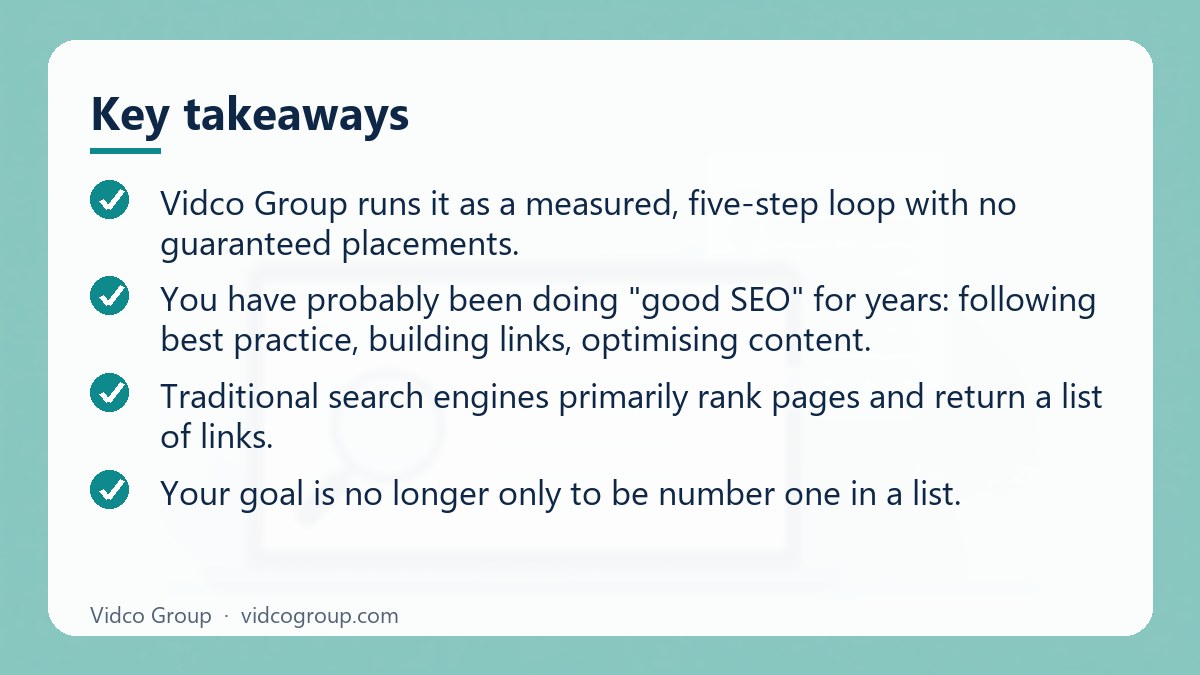
You have probably been doing “good SEO” for years: following best practice, building links, optimising content. Yet organic visibility stalls, because more of the answer is now written by a model that retrieves fragments from many sources, often without sending a click. This page explains how LLM SEO differs from classic SEO, what our service includes and excludes, how we measure it, what you receive, and how to judge any provider, including us.
Contents
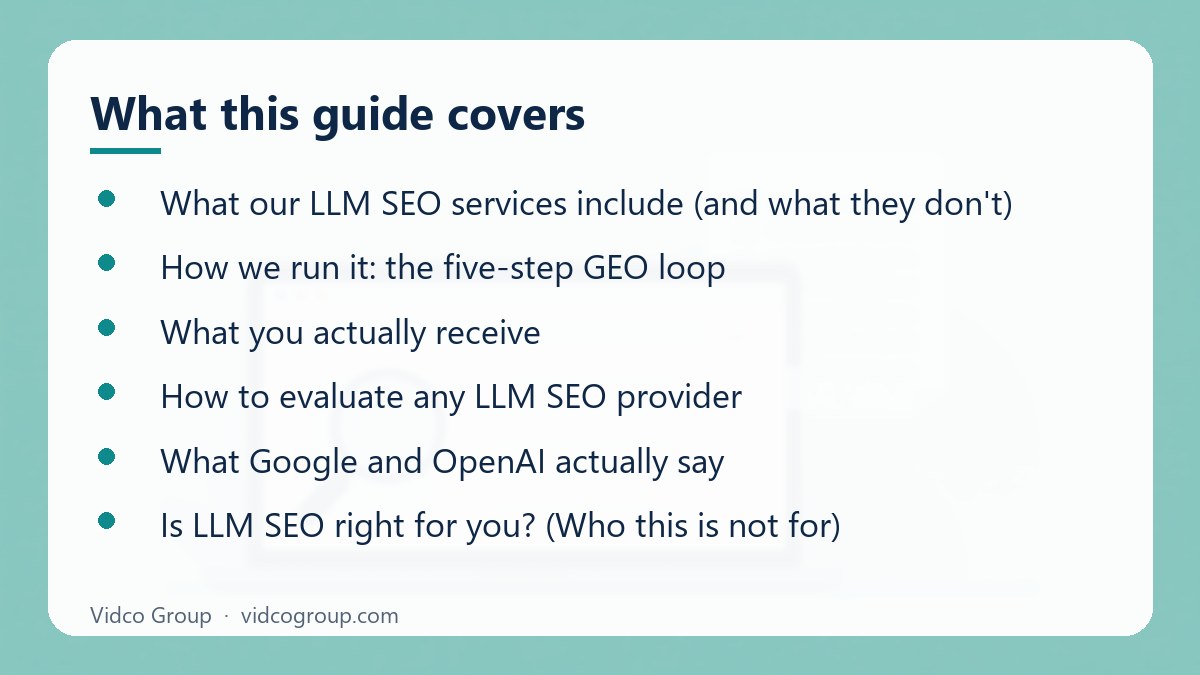
- From ranking to retrieval and assembly
- Training data vs. live retrieval
- What our LLM SEO services include (and what they don’t)
- How we run it: the five-step GEO loop
- What you actually receive
- How to evaluate any LLM SEO provider
- What Google and OpenAI actually say
- Is LLM SEO right for you?
- Common mistakes we see
- Frequently asked questions
- Next step
- Sources
The shifting sands of search: from ranking to retrieval and assembly
Traditional search engines primarily rank pages and return a list of links. Large language models (LLMs) assemble a direct answer by retrieving and synthesising fragments of information, often without sending the reader to a URL. Your goal is no longer only to be number one in a list. It is to be a piece of the answer itself, or the source the model chooses to cite.
That changes how you treat content: not only as a destination for human eyes, but as structured, verifiable statements a machine can lift. The table shows where classic SEO assumptions break down and what replaces them.
| SEO assumption (traditional) | Why it breaks with LLMs | What replaces it (LLM-first tactic) |
|---|---|---|
| Keyword density / exact match | LLMs understand meaning and context beyond exact phrases; over-optimised copy reads unnaturally and is harder to extract. | Semantic relevance and contextual depth: cover the topic comprehensively, state entity relationships, answer intent holistically. |
| Page authority / backlinks | Links still help discovery, but a model weighs factual accuracy, verifiability and internal consistency, not link count alone. | Source credibility and verifiability: demonstrable expertise, cited sources, consistent data, clear evidence. |
| Click-through rate | Models often answer directly; your content can be used without a visit. | Extractability and answerability: concise answers to specific questions, lists, tables, definitions. |
| Ranking number one | A model may blend several sources, so position one does not guarantee inclusion. | Being the definitive, structured source for a specific fact or answer. |
| Content length as a proxy for depth | Models need specific facts quickly; padding and repetition get in the way. | Information density: full detail where needed, key facts easy to isolate. |
Training data vs. live retrieval: two fronts for LLM visibility
LLMs meet your content in two ways: through what they learned during training and through live retrieval when they look things up at question time. Each needs a different, complementary strategy.
| Training data presence | Live retrieval (RAG) | |
|---|---|---|
| What it is | Content absorbed into the model’s foundational knowledge of topics, entities and relationships. | The model searches or retrieves up-to-date sources at question time, then writes the answer from them. |
| Time horizon | Long-term; changes are visible only when models are updated. | Shorter-term; changes can be picked up as pages are re-crawled. |
| Main tactics | Deep, authoritative evergreen content; factual consistency; entity and relationship clarity; a credible domain. | Structured data (Schema.org), clear answer patterns, freshness, tabulated facts with sources, logical internal linking. |
| Main risk | Contradictory or thin information across your own site. | Facts that are hard to extract, outdated or not crawlable. |
Both matter. Foundational authority builds trust over time, while retrieval optimisation keeps you present for immediate questions. For the wider discipline, see our overview of generative engine optimisation.
What our LLM SEO services include (and what they don’t)
| Included | What it means in practice |
|---|---|
| LLM content audit and strategy | A review of existing assets for extractability, factual consistency and semantic depth, followed by a prioritised roadmap. |
| Semantic content architecture | Guidance on structuring content so entities, attributes and relationships are clear to machines. |
| Advanced structured data | Expert advice and implementation support for Schema.org markup, including specialised types such as QAPage and FactCheck where they genuinely apply. |
| Authority and trust signals | Strengthening verifiable expertise, authoritativeness and trustworthiness (E-E-A-T). |
| Direct-answer formatting | Recommendations for concise answers, summary blocks and digestible data points. |
| LLM answer-pattern monitoring | Where feasible and ethical, monitoring how leading LLMs source and synthesise information in your industry. |
| Internal linking and site architecture | Clear pathways so AI systems can find and understand the depth of your coverage. |
What is not included:
- Guarantees of specific LLM answer inclusion. The internals of LLMs are proprietary and keep changing; we maximise likelihood and cannot promise citations.
- Manipulation of LLM training data. We do not use unethical tactics to influence models artificially.
- Traditional link building as the sole focus. Links still matter for authority, but content quality and structure come first.
- Direct content creation or copywriting. We provide strategic guidance; writing new content or extensive rewrites is typically a separate add-on project.
- Paid advertising management. Our focus is organic visibility through LLM optimisation.
- Generic “SEO hacks”. No short-term black-hat tactics that risk long-term penalties.
How we run it: the five-step GEO loop
- Baseline. 50–100 buying questions, none containing your brand name. Raw answers are saved. Nothing on the site changes until there are numbers.
- Split. Separate “the model never names us” from “the model names us but never links us”. These are different failures and almost nobody separates them.
- Entity. Make your name, address, sector and people agree everywhere you appear, so the model can resolve you as one thing.
- Source. Get present in the third-party places models actually read, such as roundups, association listings and review platforms, rather than adding more pages to your own site.
- Re-measure. Same prompt set, same engines, same scoring. Changing the measurement is how vendors manufacture fake progress.
Step 2 came out of our own numbers: a 0% mention rate on a 37-prompt agency question set while carrying 2,185 citations on knowledge questions. Read as one number, that looks like failure. Read as two, it is a clear instruction about what to fix: the site was being cited as a knowledge source but not recommended when buyers asked who to hire.
Why the mention and citation split matters
A mention is the model naming your brand in its answer. A citation is the model linking to or attributing your page. A brand can have plenty of citations and no mentions, or the reverse. The fix differs: low mentions usually point to weak entity consistency and thin third-party presence; low citations usually point to pages that are hard to quote. Treating them as one metric hides the problem.
What you actually receive
| Deliverable | What it is | The question it answers |
|---|---|---|
| AI Visibility Baseline | Mention rate, citation rate, share of model, plus every raw answer | Where do I stand, and where did that number come from? |
| Competitor Mention Board | Count of every brand the model named in the same run | Who does the model currently treat as my category leader? |
| Mention–Citation Split | Which of the two failures you have | Do I need content, or outside presence? |
| Entity Consistency Map | Your details across every source, with mismatches marked | Why can’t the model resolve who I am? |
| Citability Rewrite List | Pages to rewrite, with before/after sentences | What exactly do I change? |
| Third-Party Source Plan | Where to be present, ranked by influence on being named | Where do I go to get mentioned? |
| 90-Day Priority Roadmap | Ordered by impact, not by what is easy | What first, what next, and why that order? |
The prompt set and the raw data are yours. When the engagement ends you take them, and any vendor can re-run the same measurement to check our work.
How to evaluate any LLM SEO provider
LLM SEO is young, and many claims cannot be independently verified. Use these checks with every provider, including Vidco Group.
| Question to ask | Good answer | Red flag |
|---|---|---|
| How do you measure results? | A fixed prompt set, named engines, saved raw answers, repeatable scoring. | A single “AI visibility score” with no raw data behind it. |
| Do you guarantee citations? | No; they explain likelihood and method. | Guaranteed “#1 in ChatGPT” or fixed placements. |
| Who owns the data? | You do, and you can re-run it elsewhere. | Proprietary dashboards you lose access to. |
| What do you change first? | Evidence-led priorities, including off-site presence. | “More content” for every problem. |
| How do you handle model changes? | Re-measure on a schedule and report movement honestly. | Changing the measurement when results dip. |
| What tactics are off the table? | No manipulation of training data, no hidden text, no fake reviews. | Vague talk of “AI hacks” or prompt injection into pages. |
What Google and OpenAI actually say
Good LLM SEO starts from what the platforms document, not from folklore.
- Google AI features. Google’s documentation states there are no additional requirements to appear in AI Overviews or AI Mode, and no special optimisations beyond standard SEO fundamentals. A page must be indexed and eligible to show with a snippet, and important content should be available as text. Google also says no special schema or AI-specific files are needed. That is why our work focuses on clarity, consistency and evidence rather than tricks.
- Reporting. Traffic from AI Overviews and AI Mode is counted in the Web search type of the Search Console Performance report, not as a separate metric, so it must be inferred with care.
- OpenAI crawlers. OpenAI documents separate crawlers: OAI-SearchBot surfaces sites in ChatGPT search features, GPTBot crawls content for training foundation models, and ChatGPT-User handles user-initiated actions. Disallowing OAI-SearchBot keeps a site out of ChatGPT search answers, while disallowing GPTBot does not affect search appearance. OpenAI notes robots.txt changes can take about 24 hours to take effect.
- Research. The “GEO: Generative Engine Optimization” paper (KDD 2024) reported visibility gains of up to 40% in generative engine responses from certain content methods. Treat that as evidence that structure and citations matter, not as a promise for your site.
The practical consequence: check that your robots.txt does not block the crawlers you want, make sure key pages are indexable text, and put your effort into facts that are accurate, consistent and easy to quote.
Is LLM SEO right for you? (Who this is not for)
This service is for you if:
- You are a brand or organisation whose authority, expertise and factual accuracy are central to your reputation.
- You have valuable, information-rich content, or the capacity to create it.
- Traditional SEO is yielding diminishing returns, or you expect AI answers to cut into organic traffic.
- You accept a strategic, often longer-term investment in content quality and technical infrastructure.
- Your customers ask complex questions and want direct answers, not just product listings.
This service is not for you if:
- Your business relies almost exclusively on local “near me” searches with minimal informational content needs.
- You want quick, guaranteed first-page rankings through manipulative tactics.
- You have minimal content and are unwilling to invest in high-quality, authoritative information.
- Your goal is solely direct sales through e-commerce product pages without a significant informational component.
- You expect quantifiable return within weeks.
Common mistakes we see
- Blocking the wrong crawler. A blanket AI-bot block can remove you from ChatGPT search along with training.
- Inconsistent entity data. Different company names, addresses or descriptions across directories make it hard for a model to treat you as one entity.
- Publishing more pages instead of earning mentions elsewhere. Models often read third-party roundups and listings more than your own blog.
- Measuring with prompts that include your brand name. Real buyers do not; use unbranded buying questions.
- Treating one score as the truth. Without the mention and citation split you will not know what to fix.
- Skipping technical SEO. Models cannot use pages they cannot crawl; see our technical SEO work.
Frequently asked questions
What are LLM SEO services?
LLM SEO services optimise your content, entity data and third-party presence so large language models can find, understand and cite your brand when answering questions. They combine content structure, structured data, consistency work and measurement across AI engines.
How quickly will I see results from LLM SEO?
It depends on your current content health and competition. Improvements in extractability and structured data can show impact within a few months, especially for live retrieval. Becoming a foundational source for training data is longer-term, often 6–12 months or more.
Does LLM SEO replace traditional SEO?
No. It augments it. Technical health, speed and a logical structure remain essential for AI systems to crawl your content. LLM SEO focuses on the content and its presentation, built on a sound traditional foundation.
What kind of content is best suited for LLM SEO?
Factual, authoritative, well-structured content: in-depth guides, how-to articles, definitions, FAQs, data-rich reports and product comparisons, anywhere clear and verifiable answers are given.
How do you measure the success of LLM SEO?
We track organic visibility for informational queries, direct answer inclusions where attributable, branded and non-branded organic traffic, and changes in how LLM-powered interfaces reference your content. Our baseline also reports mention rate, citation rate and share of model on a fixed prompt set, re-run on the same engines.
Can you guarantee that ChatGPT or Gemini will recommend us?
No. Model behaviour is proprietary and changes. We work to increase the likelihood and show the evidence, and we do not sell guaranteed placements.
Is LLM SEO the same as GEO or AEO?
They overlap. GEO (generative engine optimisation) and AEO (answer engine optimisation) are used for the same goal of being chosen in generated answers. LLM SEO emphasises how language models retrieve and cite sources. See our AI SEO agency page for scope.
What does it cost?
Scope depends on your category, the number of buying questions and the amount of off-site work. See our pricing page for current information, or request an AI Visibility Audit to size the work.
Next step: measure before you commit
The cleanest way to start is the measurement, not the pitch. Send us your domain and we run the baseline on your category prompts, then return the raw answers alongside the score so you can check our working. From there you can decide whether to fix it yourself, with a partner, or with Vidco Group.
Vidco Group can help: request an AI Visibility Audit or contact the team. Phone: +84 34 301 8345.
Sources
- Google Search Central: AI features and your website
- OpenAI: Overview of OpenAI crawlers
- Aggarwal et al., GEO: Generative Engine Optimization (arXiv)
- Schema.org: Getting started with schema.org
- Google Search Central: Creating helpful, reliable, people-first content
Updated: October 2026.